Friday, April 13, 2007

Charlie Chaplin

Sir Charles Spencer Chaplin, Jr. KBE (April 16, 1889 – December 25, 1977), better known as Charlie Chaplin, was an English comedy actor, becoming one of the most famous performers in the early to mid Hollywood cinema era, and also a notable director and musician. He is considered to be one of the finest mimes and clowns caught on film and has greatly influenced performers in this field.

Chaplin was one of the most creative and influential personalities in the silent film era: he acted in, directed, scripted, produced, and eventually scored his own films. His working life in entertainment spanned over 65 years, from the Victorian stage and music hall in England as a child performer, almost until his death at the age of 88.

His principal character was "The Tramp" (known as "Charlot" in France, Italy, Spain, Greece, Portugal and Turkey): a vagrant with the refined manners and dignity of a gentleman who wears a tight coat, oversized trousers and shoes, a bowler hat, carries a bamboo cane, and has a signature toothbrush moustache. Chaplin's high-profile public and private life encompassed highs and lows of both adulation and controversy.


Chaplin's relationships with various women were an important part of his life and career, in both positive and negative ways.

Charlie Chaplin and Hetty Kelly

Hetty Kelly was Chaplin's 'true' first love, a dancer Chaplin instantly fell in love with when she was 15 and he almost 19, when Kelly was performing before him in a London music hall. Chaplin asked if she would meet him the following weekend and she agreed.[citation needed] Chaplin fell madly in love with her and asked her to marry him. When she refused, Chaplin suggested it would be best if they did not see each other again. He was crushed when she agreed. Years later, her memory would remain a 'fetish' with Chaplin. He was devastated in 1921 when he found out that she had died of influenza during the great epidemic of 1918.

Charlie Chaplin and Edna Purviance

Chaplin and his first major leading lady, Edna Purviance, were involved in a close romantic relationship during the production of his Essanay and Mutual films in 1916–1917. The romance seems to have ended by 1918, and Chaplin's marriage to Mildred Harris in late 1918 ended any possibility of reconciliation. Purviance would continue as leading lady in Chaplin's films until 1923, and would remain on Chaplin's payroll until her death in 1958. She and Chaplin spoke warmly of one another for the rest of their lives.

Charlie Chaplin and Mildred Harris

On October 23, 1918, the 29-year-old Chaplin married the 16-year-old popular child-actress, Mildred Harris. The marriage resulted from a false-alarm pregnancy claim from the under-age Harris. They had one child, Norman Spencer Chaplin (also known as "The Little Mouse"), who died in infancy; they divorced in 1920. During the divorce, Chaplin claimed Harris had a lesbian affair with noted actress of the time Alla Nazimova, well known for seducing young actresses. Harris in turn claimed Chaplin was a sexual addict.

Charlie Chaplin and Pola Negri

Chaplin was involved in a very public relationship and engagement to the actress Pola Negri in 1922–23. Negri was a Polish actress who had recently arrived in Hollywood to star in films. The stormy on-off engagement was halted after about nine months, but in many ways it foreshadowed the modern stereotypes of Hollywood star relationships. Chaplin's public involvement with Negri was unique in his public life. By comparison he strove to keep his other romances and relationships very discreet and private (usually without success). Many biographers have concluded the affair with Negri was largely for publicity purposes.

Charlie Chaplin and Lita Grey

Firstly, Chaplin met Lita Grey during the filming of The Kid. Then, at 35, he became involved with 16-year-old Lita Grey during preparations for The Gold Rush. They married on November 26, 1924 after she became pregnant. They had two sons, the actors Charles Chaplin Jr. (1925–1968) and Sydney Earle Chaplin (1926–). The marriage was a disaster, with the couple hopelessly mismatched. Their extraordinarily bitter divorce in 1928 had Chaplin paying Grey a then-record-breaking $825,000 settlement, on top of almost one million dollars in legal costs. The stress of the sensational divorce, compounded by a federal tax dispute, allegedly turned his hair white. The publication of court records, which included many intimate details, led to a short-lived campaign against him. The Chaplin biographer Joyce Milton asserted in Tramp: The Life of Charlie Chaplin that the Grey-Chaplin marriage was the inspiration for Vladimir Nabokov's 1950s novel Lolita.


Charlie Chaplin and May Reeves

May Reeves was originally hired to be Chaplin's secretary on his 1931-1932 extended trip to Europe, dealing mostly with reading his personal correspondence. She worked only one morning, and then was introduced to Chaplin, who was instantly infatuated by her. May became his constant companion and lover on the trip, much to the disgust of Chaplin's brother Syd. After Reeves also became involved with Syd, Chaplin ended the relationship and she left his entourage. Reeves chronicled her short time with Chaplin in her book, "The Intimate Charlie Chaplin".

Charlie Chaplin and Paulette Goddard

Charlie Chaplin and Paulette Goddard in Modern Times (1936), the final screen appearance of the Tramp.

Chaplin and actress Paulette Goddard were involved in a romantic and professional relationship between 1932 and 1940, with Goddard living with Chaplin in his Beverly Hills home for most of this time. Chaplin "discovered" Goddard and gave her starring roles in Modern Times and The Great Dictator. Refusal to clarify their marital status is often claimed to have eliminated Goddard from final consideration for the role of Scarlett O'Hara in Gone with the Wind. After the relationship ended in 1940, Chaplin and Goddard made public statements that they had been secretly married in 1936. But these claims were likely a mutual effort to prevent any lasting damage to Goddard's career, because Chaplin privately confirmed they were never officially married. In any case, their common-law marriage ended amicably in 1942, with Goddard being granted a settlement. Goddard went on to a major career in films at Paramount in the 1940s, working several times with Cecil B. DeMille. She lived her later life in Switzerland, like Chaplin.

Charlie Chaplin and Joan Berry

Chaplin had a brief affair with Joan Berry in 1942, whom he was considering for a starring role in a proposed film, but the relationship ended when she began harassing him and displaying signs of severe mental illness (not unlike his mother). Chaplin's brief involvement with Berry proved to be a nightmare for him. After having a child, she filed a paternity suit against him in 1943. Although blood tests proved Chaplin was not the father of Berry's child, the tests were then inadmissible as evidence in court, and he was ordered to support the child. The injustice of the ruling later led to a change in California law to allow blood tests as evidence. Federal prosecutors also brought Mann Act charges against Chaplin related to Berry in 1944, of which he was acquitted. Chaplin's public image in America was permanently damaged by these sensational trials.[2]

Oona O'Neill

During Chaplin's legal trouble over the Berry affair, he met Oona O'Neill, daughter of Eugene O'Neill, and married her on June 16, 1943. He was 54; she had just turned 18. The elder O'Neill refused all contact with Oona after the marriage, up until his death. O'Neill and Chaplin each seemed to provide elements missing in the others' lives: she longed for the love of a father figure, and Chaplin craved her loyalty and support as his public popularity declined. The marriage was a long and happy one, with eight children. They had three sons: Christopher, Eugene and Michael Chaplin and five daughters: Geraldine, Josephine, Jane, Victoria and Annette-Emilie Chaplin. Oona survived Chaplin by fourteen years, but her final years were unhappy, with grief over Chaplin's death eventually leading to alcoholism. She died from pancreatic cancer in 1991.

Tuesday, April 10, 2007

Alfred Hitchcock biography

From Wikipedia, the free encyclopedia
Jump to: navigation, search
Alfred Hitchcock

Birth name Alfred Joseph Hitchcock
Born August 13, 1899
Leytonstone, London, England, UK
Died April 29, 1980, aged 80
Bel Air, Los Angeles, USA
Spouse(s) Alma Reville (married December 2, 1926) 1 child
Academy Awards
Nominated: Best Director Nominations
1940 Rebecca
1944 Lifeboat
1945 Spellbound
1954 Rear Window
1960 Psycho

Sir Alfred Joseph Hitchcock, KBE (August 13, 1899 – April 29, 1980) was a highly influential film director and producer who pioneered many techniques in the suspense and thriller genres. He directed more than fifty feature films in a career spanning six decades, from the silent film era, through the invention of talkies, to the colour era. Hitchcock was among the most consistently successful and publicly recognizable directors in the world during his lifetime, and remains one of the best known and most popular directors of all time, famous for his expert and largely unrivalled control of pace and suspense throughout his movies.

Hitchcock was born and raised in Leytonstone, London, England. He began his directing career in the United Kingdom in 1922, but from 1939 he worked primarily in the United States and applied for U.S. citizenship in 1956. Hitchcock and his family lived in a mountaintop estate high above Scotts Valley, California, from 1940 to 1972. He died of renal failure in 1980.

Hitchcock's films draw heavily on both fear and fantasy, and are known for their droll humour. They often portray innocent people caught up in circumstances beyond their control or understanding.

Rebecca was the only one of his films to win the Academy Award for Best Picture, although four others were nominated. However, Hitchcock never won an Academy Award for Best Director. He was awarded the Irving G. Thalberg Memorial Award for lifetime achievement in 1967, but never personally received an Academy Award of Merit.

Until the later part of his career, Hitchcock was far more popular with film audiences than with film critics, especially the elite British and American critics. In the late 1950s the French New Wave critics, especially Éric Rohmer, Claude Chabrol, and François Truffaut, were among the first to see and promote his films as artistic works. Hitchcock was one of the first directors to whom they applied their auteur theory, which stresses the artistic authority of the director in the film-making process.

Hitchcock's innovations and vision have influenced a great number of filmmakers, producers, and actors. His influence helped start a trend for film directors to control artistic aspects of their movies without answering to the movie's producer.

Hitchcock once commented, "The writer and I plan out the entire script down to the smallest detail, and when we're finished all that's left to do is to shoot the film. Actually, it's only when one enters the studio that one enters the area of compromise. Really, the novelist has the best casting since he doesn't have to cope with the actors and all the rest."

Hitchcock would storyboard each movie down to the finest detail. He was reported to have never even bothered looking through the viewfinder, since he didn't need to do so, though in publicity photos he was shown doing so. He also used this as an excuse to never have to change his films from his initial vision. If a studio asked him to change a film, he would claim that it was already shot in a single way, and that there were no alternate takes to consider. However, respected film critic Bill Krohn in his book Hitchcock At Work has questioned the popular notion of Hitchcock's reliance on storyboards. In his book, Krohn after researching script revisions of Hitchcock's most popular works, concludes that Hitchcock's reliance on storyboards has been exaggerated and argues that Hitchcock only storyboarded a few sequences and not each and every scene as most think. He also notes that this myth was largely perpetuated by Hitchcock himself.

Similarly much of Hitchcock's hatred of actors has been exaggerated. Hitchcock simply did not tolerate the method approach as he believed that actors should only concentrate on their performances and leave work on script and character to the directors and screenwriters. In a Sight and Sound interview, he stated that, ' the method actor is OK in the theatre because he has a free space to move about. But when it comes to cutting the face and what he sees and so forth, there must be some discipline'. During the making of Lifeboat, Walter Slezak, who played the German character, stated that Hitchcock knew the mechanics of acting better than anyone he knew. Several critics have observed that despite his reputation as a man who disliked actors, several actors who worked with him gave fine, often brilliant performances and these performances contribute to the film's success.

Regarding Hitchcock's sometimes less than pleasant relationship with actors, there was a persistent rumor that he had said that actors were cattle. Hitchcock later denied this, typically tongue-in-cheek, clarifying that he had only said that actors should be treated like cattle. Carole Lombard, tweaking Hitchcock and drumming up a little publicity, brought some cows along with her when she reported to the set of Mr. and Mrs. Smith. For Hitchcock, the actors, like the props, were part of the film's setting.

The first book devoted to the director is simply named Hitchcock. It is a document of a one-week interview by François Truffaut in 1967. (ISBN 0-671-60429-5)

Friday, April 06, 2007

The Story of A Stupid Boy

"Alas! What a stupid son I have! I am worried that he will not be ableto preserve all of the property if I hand down to him. There was a wealthy man who was very astute and capable. However, he had a son who was very stupid and good-at-nothing. Hence the wealthy man had been very distressful.
One day he was again sat down in the living room and sighed. His son was sitting opposite to him and was just mindlessly giggling, "Hihi, hehe!!" "Ai", the wealthy man could not help making a sigh. Then the family old maid came in and said,
"Master, there's a monk looking for you for donation."
The wealthy man had been a person who knew how to respect the Buddhists. Therefore upon hearing that, he said,
"Please invite him in immediately."
Soon an old monk who looked very compassionate came in. The wealthy man very politely requested him to sit down. The old monk did not sit down. Instead he directly walked towards the stupid son and looked at him. Then the old monk slowly touched his head for a few times and said,
"In fact,this child is very clever and is good at studying. It's a pity that there's too much killing in your home. And this prevent him from being clever."
He left without looking back when he finished the remarks. There left the wealthy man to think of the remarks of the old monk,
"The old monk was right. Truly our family have been consuming big fishes and much meat without stopping. Also we always throw dishes away when we cannot finish them. And every festivals we will have delicacies from land and sea. Perhaps it has been because we have been slaughtering many animals at home that resulted in having an idiotic son."
From then onwards, the wealthy man changed himself completely - The wholefamily started to become vegetarian. He banned anyone to take all liveanimals into the kitchen. In addition, he spent much money to buy animalsto release them in the wild as a work of merit. Thus he had been doing for many years.
Suddenly one day the stupid son of the wealthy man ran to the father held his stomach and shouted,
"Papa, my stomach's aching and I want to vomit."
The wealthy man was very worried. He was just about to invite a doctor to treat his son when the son started to vomit some "black liquid". Everyone was astonished upon seeing it. However, the stupid son became very intelligent since then. No longer anidiot any more, he mastered anything he learnt in no time. The wealthy man was very happy so he let his son studied. Finally the son attained the best results in the government examination. This confirmed what the oldmonk had said before.

Thursday, January 11, 2007

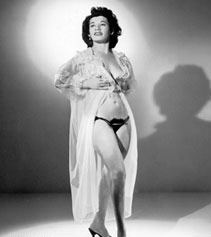
Flora - The oldest porn star in the world

Flora the oldest porn star

Flora, bubbly, tiny, maybe 5 feet tall, woman in her 83 years is the oldest porn star in the world. Before she get into adult movies business, Flora was a dancer, she produces movies (B production - "Mother of the Vampire", "Criminally Insane II", "Cemetery Sisters", ...), and she has been married seven times. She lives with her niece in Las Vegas suburbs, goes to nightclubs, drives car like a race driver, ... Now, she is a porn star. Flora says she loves sex. And she loves man. Young man, especially. The last partner in movie was 26 years old. And Flora is proud on that position.
Flora started with her new business only 6 months ago. Her 73 years old friend Jeanette, is a model. And her introduced Flora with adult movies produces. He offered her $700 for a scene in a series called "Century Sex". And Flora accepted. Since that she already made several porn movies. Now, she is writing script for a movie about her life.

Monday, December 04, 2006

Steve Irwin

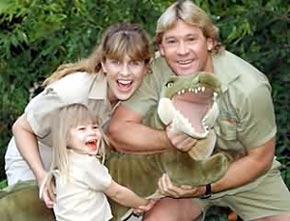
Steve Irwin with family

Steve Irwin - wild animals expert


Steve Irwin was born on February 22. 1962, in Essendon, Victoria, Australia. He was mixed TV entertainer and wildlife expert. Almost everyone in the World know about Irvin's "The Crocodile Hunter", TV series he made with his wife Terri. Animal Planet presented that famous documentary series about life in jungle, swamp, wild rivers, ... And lots of networks wide republished show for people. Steve Irwin had no any scientific degree but he knew about wild animals very, very much. Sometimes lots more that some scientists. He worked in Australia Zoo at start, where he felled in love with crocodiles . In 1991, Steve and his wife Terri spend part of their honey-moon with crocodiles filming them. In 1992 they produced "The Crocodile Hunter" first time, and 1996. Animal Planet decided to air that fabulous TV show, and people in more than 200 countries around the World had a chance to watch it. Stewe Irwin was very enthusiastic and had no fear of crocodiles, snakes, spiders and other creatures filming them. Although, danger was there in every show. He become so famous, "South Park" and "The Simpsons" wad some parodies on his Crocodile Hunter in some episodes.

On September 4, 2006, Snorkeling near a stingray, Steve was pierced in the chest by its barb, which hit his heart and he died.

Wednesday, November 15, 2006

Helene Grimaud - wolf woman

Helene Grimaud is a French pianist with one more big passion besides music. Wolves. She fallen in love with wolves back in 1991. in Florida, when she took her friends dog in a walk, and meet wolf. In fact, that was part she-wolf, part dog, but there was chemistry between Helene and that part-wolf.

Wolf Conservation Center

In 1999. Helene Grimaud and J. Henry Fair, her companion in that time, opened "The Wolf Conservation Center". That educational facility is placed in South Salem, New York. To be more precisely, about 80 km from Manhattan. Wolf Center is 12 hectares big, and 17 wolves live in it. 13 wolves are shielded from public, living in real nature and preparing to be returned into wild nature. 4 wolves are just like pets there. They are socialized, and they are on view to public.
At first year, Wolf Conservation Center had about 500 visitors, but last year we could see real popularity of it. About 20.000 people came to visit wolves in Center. Helene is so proud on it.

Helene Grimaud picture

And just a little about Helene - pianist. In 2006, she played concerts with concerts with the London Symphony Orchestra, Chamber Orchestra of Europe, St Petersburg Philharmonic, the Deutsche Kammerphilharmonie, NHK Symphony Orchestra, Gulbenkian Orchestra and many others. Like she said, music and wolves are her life and salvation.

Wednesday, November 01, 2006

Mikael Genberg - fun artist

Mikael fun artist

Mikael Genberg is a Swedish artist and sculptor with very interesting and unusual ideas. He designs hotels, cafes and other buildings on fun way. He is trying to mix usability and fun on original way.


Woodpecker Hotel

woodpecker interesting hotel

This unusual hotel, opened in 1998, is placed on oak tree, in city park, Vasaparken, Sweden. Hotel is 13 meters above the ground and guests must climb up with rope ladder to their room. In fact, there is only one room with one bed, so hotel is prepare for one guest in a time. Two guests are welcome, too if they don't mind share a bed. Meals are served to guests via a basket attached to a fun pulley. Woodpecker Hotel have bedroom, kitchen, veranda with hammock and a toilet. Place is interesting to tourists, so it's quite popular during the summer.


Utter Inn

Utter Inn

Another interesting hotel design of Mikael Genberg, made in year 2000. Utter Inn is placed on the Lake Mälaren in Västerås, Sweden. Hotel have two parts. One, above water and another under water. On water is little red house, where visitors can look at the lake, drink coffee and enjoy the sightsee. Three meters underwater is room for sleeping (if you can sleep in that conditions), with hard glass windows, so you will feel like you are in aquarium. Feel of adventure will make your adrenaline high, that's for shore. The guests starts the tour at the port of Vasteras. They will be taken the 1 km out on the lake Malaren with a boat. There guests shall get instructions and then they are left alone.


Cafe Koala

caffe koala for brave and weird

Since there are lots of coffee drinkers in Sweden, Mikael come to another fun idea. He made "Cafe Koala", cafe for eight brave guests. Tables and chairs are placed five meters above ground and you will have to climb up ladders first. You will get your coffee in a basket which is winched up by a rope.


Blog about Tourism and hotels.

Another Best destinations source.